

In the first 48 hours of the year, four signals pushed the truck tire industry toward the same answer: the future isn’t only about wear life—it’s about predictable operating outcomes
If you treat a truck tire as nothing more than a “black rubber ring,” the industry story stays painfully simple: deeper tread, tougher compounds, lower prices. But the publicly available information released on January 21–22 offered four different angles in a very short window. One came from a manufacturer’s financial resilience, another from the real cash fleets can save through tire inflation management, another from distributors expanding warehouse networks through consolidation—turning delivery speed into competitive advantage—and the last from the mounting pressure of end-of-life tires and circular materials under environmental and compliance expectations.
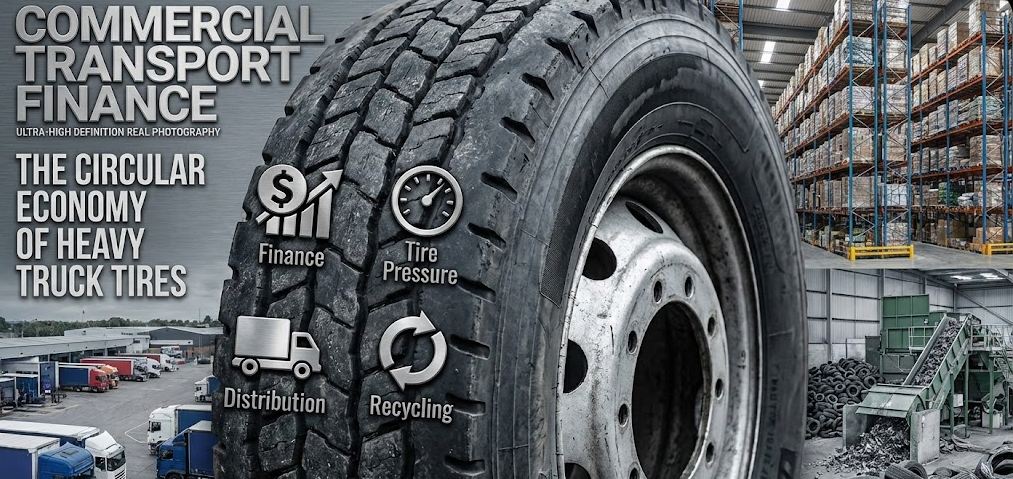
On the surface, these belong to four separate sections—finance, technology, channel, sustainability. In reality, they all point to the same thing fleets care about most: whether tires can make vehicle uptime more stable, costs more controllable, and risks more predictable.
The manufacturing backdrop: tires are still treated as a “profit engine that can hit targets,” but volatility makes companies emphasize execution certainty
On January 21, Continental released preliminary figures for FY2025, noting that at the group level and within the Tires segment, sales and adjusted EBIT margin were within guidance, and emphasizing that it achieved its full-year targets at both the group and tire-business levels.
For truck tire companies, this kind of messaging is not just earnings-call language. When macro conditions swing, freight cycles fluctuate, and fleet capex becomes hesitant, the ability to consistently deliver targets determines whether R&D, capacity, and channel investments can stay strong. In other words, “stable delivery” becomes part of brand trust—because fleets don’t buy tires once; they buy the certainty of repeated replenishment and service in the future.
The key technical variable: inflation management is evolving from “safety maintenance” into a measurable fuel-saving tool—with specific test numbers
Also on January 21, PRNewswire carried a release stating that MVT Solutions (MVTS) validated, through testing, that Aperia Technologies’ Halo tire inflation device delivered fuel savings of 1.19 gallons per 1,000 miles. The test vehicle was a 2026 Kenworth T680, run on a 9-mile track at 65 mph. The release also provided a fleet-friendly translation into cashflow: assuming fuel at $3.760 per gallon and 125,000 miles per year, annual savings were estimated at roughly $556.
The industry significance is straightforward: everyone has long known tire pressure affects fuel economy, but many fleets won’t pay for “a feeling.” When fuel savings are quantified down to “gallons per thousand miles,” and can be converted into annual dollars, inflation management stops being a checkbox on a maintenance list and becomes a budgetable, verifiable KPI.
From the fleet operations lens: both overinflation and underinflation hurt—management value lies in pulling tires back from “random events” into a controllable range
In the same release, an MVTS engineering leader noted that both excessively high and low tire pressure can harm fuel economy, and emphasized that exact values may vary by tire type and load, though the direction should remain consistent.
That line matters to truck tire companies because it highlights what fleets actually need: not a one-time “hit the number,” but keeping pressure within a stable, long-term, enforceable range. Pressure drift often comes with abnormal wear, heat buildup, and structural stress changes—ultimately surfacing in the most expensive form possible: roadside downtime. That’s why the value of inflation automation is not only fuel savings, but also a smoother tire life curve and replacement timing that stays closer to plan.
Channel-side change: the denser the warehouse network, the more comfortable fleets are reducing their own inventory—consolidation is turning delivery speed into tire competitiveness
On January 22, Modern Tire Dealer reported that Zurcher Tire’s wholesale business (including 12 distribution centers across five states) will be folded into K&M Tire. After the transaction closes on February 1, 2026, K&M Tire will operate 52 warehouses nationwide. Added coverage includes Michigan, Indiana, Illinois, Iowa, and—new for K&M—Missouri.
This story may look unrelated to “tire performance,” but it’s painfully practical for truck tire customers: as downtime becomes more expensive, being able to get the right size quickly can matter more than saving a few dollars per tire. More warehouses, shorter delivery radius, and steadier fulfillment allow fleets to carry less on-hand inventory and keep cash focused on core operations. Put simply: channel logistics capability is becoming an invisible selling point for tire brands.
Sustainability and compliance: end-of-life truck tires are massive in volume—recycling turns the tire lifecycle into a second battleground that can’t be ignored
On January 22, GlobeNewswire carried market information from Astute Analytica: the global tire recycling market was valued at around $13.92 billion in 2024, projected to reach $19.24 billion by 2033 (forecast period 2025–2033, CAGR 3.80%). It also stated that commercial vehicles play a key role in the end-of-life tire stream, noting commercial vehicles contribute roughly 112 million end-of-life tires annually, and gave a typical commercial tire replacement interval of about 50,000–75,000 miles.
For truck tire companies, this implies that “selling the tire” is only the first half of the game; the second half—how the tire is collected, recycled, and fed into the recovered-material chain—is becoming a compliance topic. As recycling discussions highlight pathways like pyrolysis and outputs such as recovered carbon black and oils, tire makers will face more direct questions and requirements around material choices, formulation design, recyclability, and supply chain transparency.
Put all four signals together: truck tires are moving from a product contest to a system delivery contest—and the system’s core is predictability
Manufacturers emphasize hitting targets and maintaining operational resilience in order to keep investing. Inflation automation uses measurable data to turn fuel savings and safety into outcomes that can be accepted and audited. Channel consolidation makes delivery speed a competitive edge and gives fleets confidence to reduce inventory. Recycling growth extends the tire story from “factory to customer” into a full chain “from production to regeneration.”
Together, these four threads drive one conclusion: in 2026, truck tire competition increasingly looks like competition among operating solutions. Fleets want each tire to run reliably at the right pressure, be replaced at the right time, be replenished quickly through the right channel, and be handled through the right end-of-life pathway. Whoever can connect those steps is more likely to win long-term contracts and stronger repeat purchase loyalty.
Practical takeaways for truck tire companies like ours: don’t sell tread alone—productize three capabilities
Capability #1: Data-driven inflation and tire health management.
Don’t only talk about wear life. Express the fuel-saving and risk-reduction value of inflation management in measurable terms—per mile, per truck-year, and as ranges under different fuel-price assumptions—so the value can be written in the same budget language fleets use (as MVTS did by translating test results into annual dollars).Capability #2: Deliverable channel service.
Warehouse coverage, lead times, and emergency SKU transfer mechanisms should become explicit promises for fleets. The consolidation trend shows the industry is competing on this and will keep pushing it harder.Capability #3: Recyclability and materials narrative.
At minimum, be able to answer customer and regulator questions about end-of-life pathways, recovered materials, and recycling partners—because recycling market data and commercial end-of-life volumes are already being repeatedly cited.Closing: the next “trump card” for truck tires may not be more aggressive wear claims—it may be steadier fleet cashflow
In trucking, the most expensive thing is rarely the tire itself—it’s uncertainty: unplanned downtime, emergency procurement, misaligned shop windows, inventory cash tied up, and compliance risk all magnify cost. The last two days of public information—through operational resilience, quantified inflation fuel savings, warehouse-network expansion, and recycling market pressure—repeated the same message: tires are becoming a system node inside fleet operations.
For tire companies, winning in 2026 won’t come only from stronger products, but from clearer outcome delivery: fuel savings you can calculate, risk you can control, supply you can fulfill fast, and recycling you can explain. Do that well, and a one-time transaction becomes a long-term partnership.
Copyright © 2024-2025 Firemax Sdn. Bhd Company. All rights reserved.
Headquarters address:303 block C, Pusat Dagangan Phileo Damansara 1, No 9 Jln 16/11 Off Jalan Damansara, 46350 Petaling Jaya, Selangor. Malaysia Sales Hotline:+60 11-6449 0688 After-sales hotline:+60 11-6449 0688